What to take into your next decision
- A checked task is not proof that an external account works.
- Make the receiving team accept each cross departmental handoff.
- Use current policy acknowledgments and employee verification at completion.
Agree the employment event and the coordinator
Start with the HR owner who can confirm the joiner, role change or departure. Agree the approved start date, team, manager and employment authority in the HR system. The coordination app should not invent an employment event from a manually entered directory card.
Name one transition coordinator and identify the operators for IT, equipment, workplace and guidance. Atria can coordinate assigned tasks, dependencies, deadlines, blockers and completion evidence. Starting that checklist does not automatically create an HR event, provision accounts, issue a device or cancel future reservations.
| Workstream | Responsible owner | Evidence to agree |
|---|---|---|
| Employment event | Authorized HR owner | Confirmed event in the HR source system |
| Software and access | Reviewer and authorized IT operator | Decision, actual provisioning result and employee verification |
| Equipment | Equipment custodian | Assignment or return with condition and custody record |
| First office day | Workplace coordinator | Required booking and reviewed arrangements |
| Guidance | Content owner and employee | Acknowledgment of the required current version |
Prepare access as a governed request
For each required application, record the access level, business purpose, reviewer and intended duration. Resolve missing information before a decision is requested. The manager, named reviewer or service owner path should reflect the organization’s actual authority, including any configured sequential review and delegation.
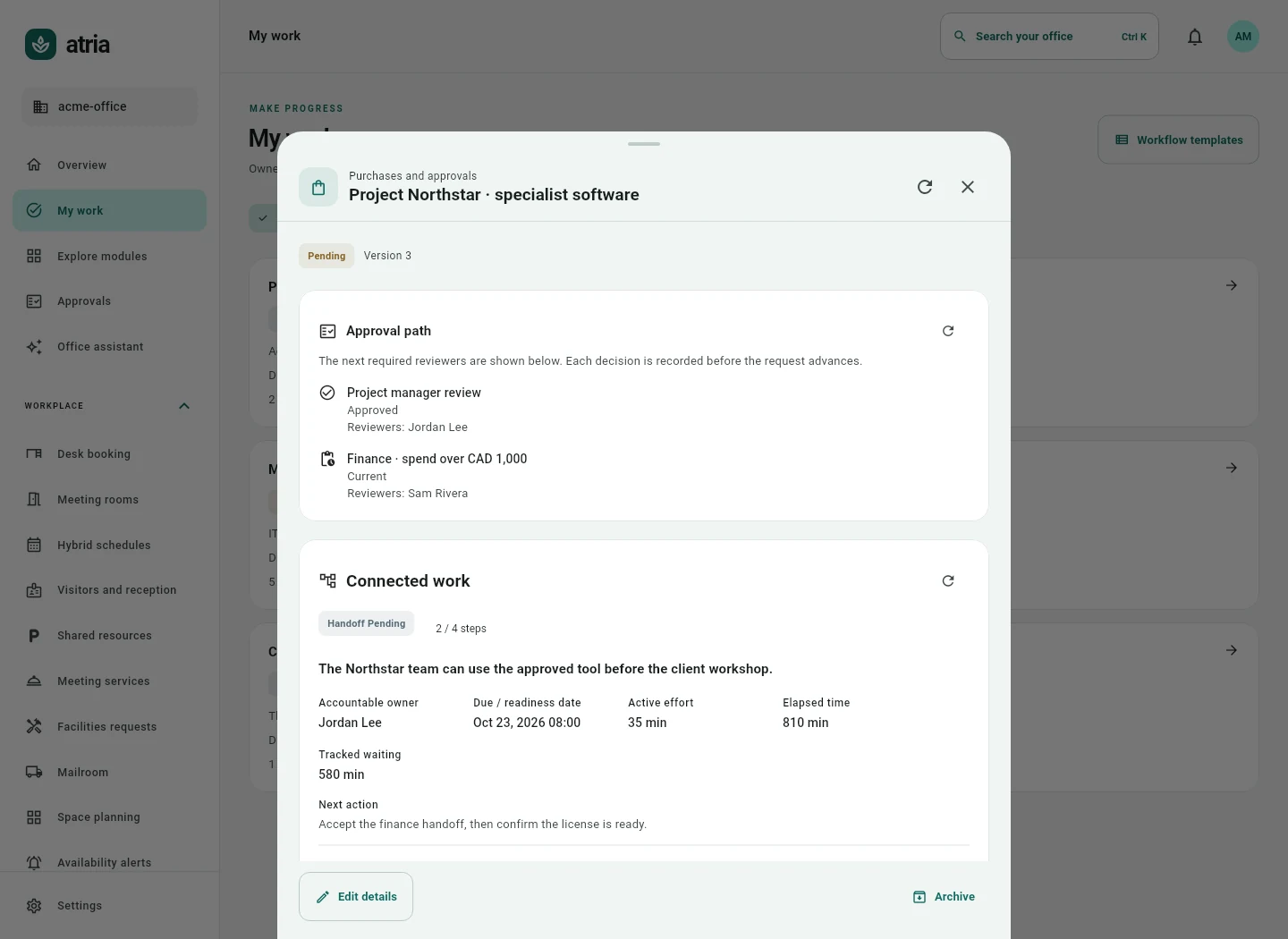
After approval, an authorized operator performs the supported source system action and records the result. Ask the employee to verify that the required access works. If fulfillment fails or is uncertain, keep that state visible and assign the next action. Avoid the shortcut of marking access complete simply because somebody approved it.
- The required account and destination are identified.
- The reviewer has appropriate authority and is not approving their own request.
- The action is supported and the operator has permission.
- Provisioning evidence and an employee verification step are defined.
Coordinate equipment and the first office day
Record equipment custody through the asset workflow, including assignment, condition and the responsible person. A reservation of a shared device is a different transaction from issuing it to an employee. Returns, repair and retirement should retain their own history.
For an office day, confirm the location, desk or room needs and any shared resource booking. A hybrid plan records an intention to attend; it does not prove physical arrival. If a meeting has visitor or service arrangements, link them to the intended occurrence so a later change can be reviewed by the responsible operators.
Keep guidance and private employee information appropriate
Assign the relevant current guidance and identify who publishes and reviews it. Atria’s knowledge campaigns can use explicit target rosters, deadlines, reminders and version specific receipt history. An acknowledgment of an earlier publication should not satisfy a revised policy.
Keep confidential employee support in the appropriate restricted workflow. Application role restrictions do not replace deployment controls, investigations governance, retention decisions or legal holds. Collect only what the onboarding process needs and agree access to employee records before live use.
Test blockers and departures, not just a smooth start
A good pilot includes a missing manager decision, an unavailable device, a failed access action and an employee who reports that access does not work. Each case should reveal an owner, a next action and a way to preserve the evidence. A completed parent checklist must not conceal an unresolved required task.
Role changes and departures need the same discipline. An instruction to remove access is not proof that the identity provider or application actually removed it. Record the source system outcome through the authorized process. A directory profile deactivation is also separate from login session revocation.
- Every required task has an owner and completion condition.
- Dependencies are valid and blockers are visible.
- Cross departmental handoffs are accepted.
- External actions have real evidence, including failures.
- The coordinator verifies the transition before closing it.
Questions and answers
Does Atria automatically provision every employee application?
No. The transition checklist coordinates work. External changes require authorized operators or specifically supported operations, with account consent, mapping and verification.
Can our HRIS remain the source of truth?
Yes. The integration discovery process records data authority and supported operations. Atria identity, directory records and HR employment events are distinct responsibilities.
Can we use the same approach for offboarding?
Yes, as a coordinated workflow with explicit tasks and evidence. Actual revocation, returns and HR changes must be confirmed in their authoritative systems.
Sources and product scope
Prepared from Atria’s implemented workflows and the linked product scope. Examples are illustrative; customer outcomes need their own pilot evidence. Published vendor prices, where used, were reviewed October 25, 2026 and need a current quote before procurement.